Working with Gaia
John Harrison
We have spent centuries engineering weapons to conquer each other on the surface of the Earth, while spending little to keep the Earth itself alive.
Humanity can guide a hypersonic missile across continents with precision, yet claims it lacks the capital or the technology to purge cancer causing synthetic poisons from municipal drinking water or clean up toxic wastes!
We mobilise trillions of dollars overnight, command our greatest mathematical minds, and overhaul entire industrial supply chains the moment a war breaks out yet we surrender to paralysis while the life-support system of the planet unravels.
More than seventy years ago, a five star general and United States President, Dwight D. Eisenhower, exposed the raw moral equation of the war machine:
“In the councils of government, we must guard against the acquisition of unwarranted influence, whether sought or unsought, by the military industrial complex”(Eisenhower, 1953).
"Every gun that is made, every warship launched, every rocket fired signifies, in the final sense, a theft from those who hunger and are not fed, those who are cold and are not clothed. This world in arms is not spending money alone. It is spending the sweat of its labourers, the genius of its scientists, the hopes of its children... Under the cloud of threatening war, it is humanity hanging from a cross of iron"(Eisenhower, 1961).
Today, that theft has expanded beyond the poor and the hungry. It is a direct theft from the living Earth. The genius of our scientists and the sweat of our labourers has been perverted into perfecting the machinery of mutual slaughter, leaving the planet defenceless against a slow, systemic poisoning with both overabundant and unknown to nature chemicals many of which are recyclable but are not recycled.
Hesoid who was an ancient Greek Poet wrote his mythic Theogony 730-700 BC in which the cosmos does not begin with moral commandments, territorial borders, or the drums of war; it begins with sheer existential emergence (Hesiod, c.700 BCE/1988). After the primal Void (Chaos) yawned open, there arose wide-bosomed Gaia, the enduring, non-negotiable physical bedrock upon which all mortal and divine reality was grounded.
The later Olympians, Zeus, Hera, Ares, and the rest were inventions of a very human frequency. They were the personification of immediate drama: catastrophic infidelities, domestic feuds, sudden divorces, territorial wars, and fickle tantrums. Olympian politics mirrored the short attention span of mortal life. But beneath all their thunderbolts and throne-room drama, the foundational substrate remained Gaia. When mortals poisoned the wells or stripped the soil bare, it was not an Olympian grudge they suffered from; it was the quiet, immovable mechanics of the Earth asserting its physical limits.
Modern society is still hopelessly trapped in the theatre of the Olympians. Our parliaments, election cycles, and corporate boardrooms operate on three-to-five-year rhythms of tribal posturing, media feuds, and ideological trench warfare. We pour our wealth and energy into fighting over borders drawn on dirt, oblivious to the fact that the living earth beneath our feet is giving way.
A century ago, the pioneering Russian geochemist Vladimir Vernadsky recognised an unprecedented turning point in natural history: humanity, through science and industry, had ceased to be a simple biological inhabitant of Earth. We had become a planetary force reshaping the chemical migration of elements, altering the crust, and transforming the biosphere (Vernadsky, 1926). I am so enthused by his foresight that there is a paper on his ideas on what was Gaia Engineering.
In the 1970s, James Lovelock and Lynn Margulis gave this living planet a modern cybernetic spine. Through the Gaia Hypothesis, they demonstrated that Earth’s atmosphere, oceans, and rocks are actively regulated in homeostatic balance by living organisms. The biosphere is not a passive passenger on a rock; it is the planet’s life-support engine (Lovelock and Margulis, 1974; Lovelock, 1979)
We have arrived at an inflection point where society must move decisively past Vernadsky, Lovelock and Margulis (Rockström et al., 2009; Steffen et al., 2011).
Classical Gaia theory operated on deep geological time. It relied on the comforting premise that life’s feedback loops would naturally buffer the planet against disturbance, as they had for nearly four billion years. Earth evolved its own organs: forests as lungs, wetlands as kidneys, oceans as a circulatory network.
Earth never evolved organs to digest human industrial hubris and is currently incapable of doing so in the short term because of:
Alien Chemistries: Humanity has flooded the world with hundreds of completely novel synthetic substances that nature's evolutionary design kit cannot process. Plastics that do not decay, and per- and polyfluoroalkyl substances (PFAS) anchored by the carbon-fluorine bond which is one of the strongest in organic chemistry. There is no native bacterium or wild enzyme capable of breaking down these chemistries.
The Delusion of the "Tide of Wish": For decades, society has tried to treat this disaster with a strong tide of wishful thinking and weaponised consumer guilt. Everyday people are told that planetary collapse is their moral failure for drinking through a plastic straw or forgetting to sort their rubbish. It is a cynical diversion. Everyday people did not design impossible polymer chains or commission Petro-refineries. Wishful thinking and personal guilt cannot break covalent bonds, and an ocean current cannot metabolise millions of tons of microplastics simply because our intentions were good.
The Structural Failure of Politics: The half-life of a fluorinated chemical or deep carbon dioxide or methane disturbance is measured in centuries. A democratic election cycle is measured in forty-eight months. You cannot correct deep thermodynamic and biogeochemical imbalances using political instruments designed solely to survive the next round of polling.
Decades ago, the visionary engineer R. Buckminster Fuller looked at our closed, vulnerable planet and coined the concept of "Spaceship Earth." He warned that humanity faced an absolute design choice: we must redirect human ingenuity from "weaponry to livingry."(Fuller, 1969).
I totally agree with him.
Fuller's insight was prophetic, but our predicament demands a far more aggressive escalation. This is no longer merely a design challenge; it is a full-scale war for biospheric survival. It demands all the urgency, all the industrial mobilisation, all the capital expenditure, and all the collective willpower of total war diverted entirely away from killing one another and thrown into keeping our life-support systems intact.
For fifty years, this crisis has languished at the flat, agonising bottom of an S-curve. The United Nations has issued dire warnings, scientists have published irrefutable data, and international summits have produced mountains of toothless pledges. The response has stayed flat because the political and financial system remains chained to short-term expediency.
Real historical transformations never occur through polite bureaucratic consensus. They ignite along the steep, vertical climb of the S-curve only when the quiet, latent dread carried by millions of everyday people hits a tipping point and crystallises into an irresistible mass demand.
I believe the majority of people already feel this dread in their bones. They worry deeply about the world their children and grandchildren will inherit, and they are sick of political theatre while their water, food, and air are poisoned. The critical mass must now demand an end to the madness: stop pouring our wealth and genius into weapons of destruction, and start building the industrial organs to recycle, neutralise, and restore what Gaia cannot handle alone.
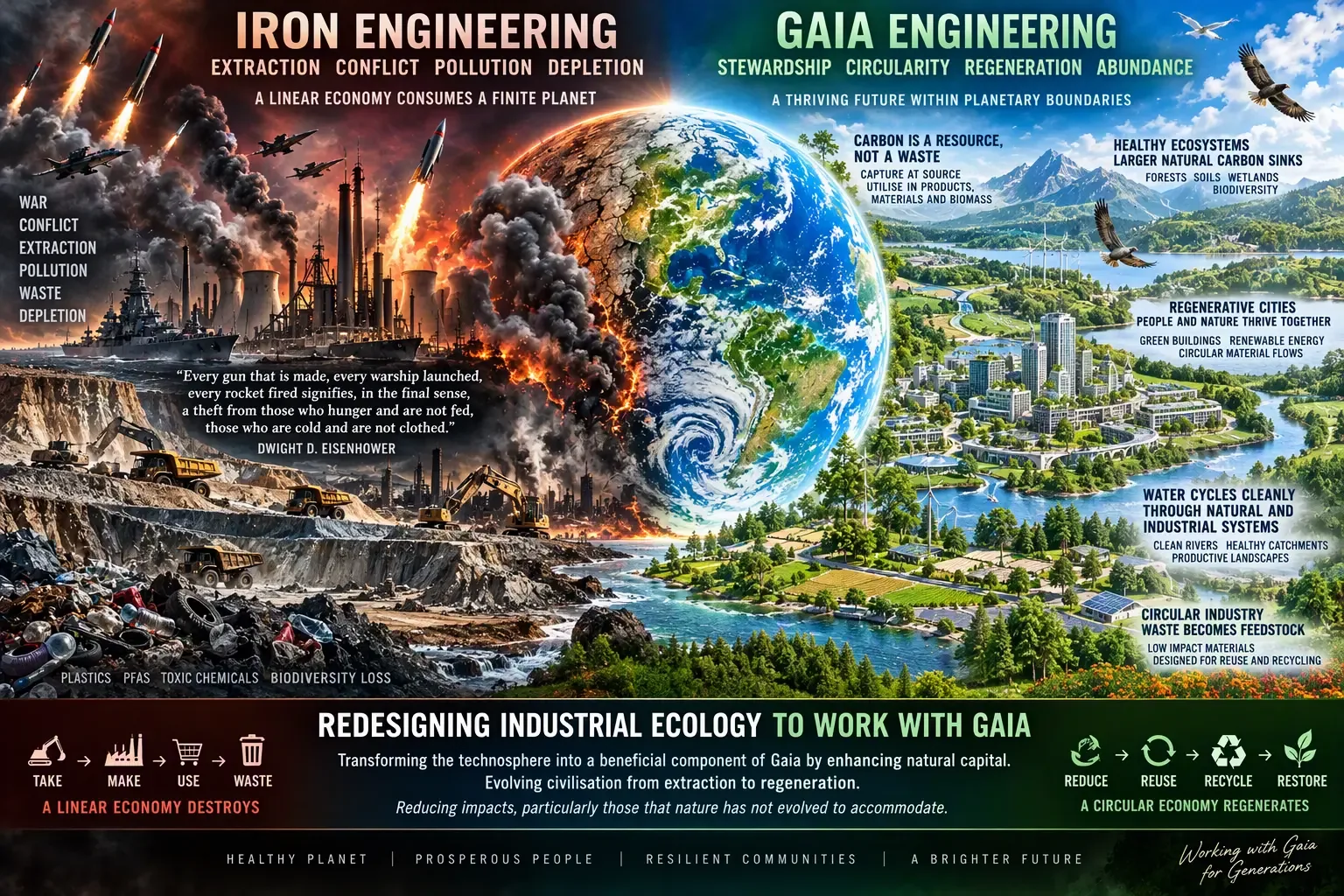
This is the non-negotiable imperative of Gaia Engineering.
I have been writing about it to provide guidance as I seek guidance myself as I love nature. I recognise I must share what I learn because it is well past the time we should be seeking action as the statistics I graph in the Problems page of this website show.
When a living system is choked with synthetic toxins it cannot metabolise, so leaving nature alone is no longer enough. As Vernadsky saw, we are already a geological force, (Vernadsky, 1926); we must now become a conscious, regenerative one. We must engineer the external means for nature to survive as there has not been enough time for evolution to develop them. Nature must survive or we will not!
Nature does not conquer waste through wishful thinking; nature builds with chemistry. The vast geological formations of this planet, the great limestone massifs, the chalk cliffs, the ancient reefs were created by living organisms that captured dissolved carbon and mineralised it into their homes and it later became permanent, unyielding stone.
It is important to immediately reverse our population growth and this will probably happen as sub-Saharan women are educated and contraceptives are more easily available. Moving down the food chain also makes a lot of sense as well as further processing desalination waste water as a sync for CO2.
Gaia Engineering goes much further and requires undoing the damage we have done and closing supply chains on a planetary scale because there is no such place as “away” to deposit waste:
Take=>Make=>Use=>Waste must become Take=>Make=>Use=>Re-use=>Recycle=>Restore
Years ago on the TecEco website in the early 2000’s I prophetically said the technology paradigm defines what is or is not a resource. New technologies are providing new ways for creating recyclable molecules from forever molecules and this important as industrial ecology including recycling must be compatible with the Eco-Sphere.
Driven electrochemistry: Will make it easier to transform waste molecules into resources we need or nature requires for us to recycle to nature.
Mineralising Industrially Produced CO2: Pyroprocessing carbonate rocks inevitably produces vast volumes of carbon dioxide. Releasing it into the air is utterly stupid, pretending we can store it in leaking subterranean voids is a half-measure. The best answer is to capture the gas and use it to sparge desalination waste water to produce calcium and magnesium carbonates for other uses or for pyroprocessing to make cements to build with in what is a second carbonating loop in the case of magnesium oxide (rMgO) used to make re carbonating Eco-Cements referred to on the TecEco website over 25 years ago mimics a big old tree and turns the built environment into a vast, artificial carbonate store and locks carbon permanently into the foundations of human civilisation.
CO2 is a vital gas for plants, which use it in photosynthesis to produce sugars and other organic compounds while releasing oxygen, both of which are fundamental to sustaining life on Earth.
Recycling, directly or indirectly using these new chemistries and new techniques to master the process of recycling is another corner stone of Gaia Engineering.
There is even room for AI to assist so to those who want to ban it please go away and think about it! Ignorance is our problem, not intelligence. There is no faster research assistant than AI
AI is essential for recognition at every scale for
Restoration is a Chemical and Engineering Task: If human engineering synthesised indestructible compounds, human engineering must use technology and computer AI to recognise and disassemble and rebuild the molecules as required for recycling. If we can send robots to Mars we can do this! If we can’t do this then burning is better than poisoning other life. (See 4. below)
War Footing for Survival (Weaponry into Livingry): The trillions of dollars, industrial capacities, and scientific intellect currently dedicated to weapons of war should be reassigned to the preservation of life. We need the modern equivalent of war bonds, generational Gaia Trusts and public utilities funded at the scale of national defence budgets structured to outlast political administrations and market swings. What we do has to pay because that is how we have evolved.
Engineering as a Planetary Organ: Human industry can no longer operate as an open-ended, extractive cancer. It must be re-engineered creating closed-loop industrial ecologies where every synthetic byproduct is recycled or restructured using chemical or electrochemical means and what can’t be used destroy by burning. (See 4. below)
Burning Indestructible Molecules: For the hundreds of complex synthetic polymers, plastics, and forever chemicals that biological enzymes cannot touch and we cannot dissemble using chemistry, driven electrochemistry or other means the only answer may be high-temperature thermal destruction. We must break the alien chemical bonds back down into their raw elemental constituents or simpler molecules that nature can use.
Gaia Engineering is not a brand; it is an ultimatum for human survival. Many of the technical solutions have existed for decades, others are newer, all are waiting only for our collective will to catch up. It demands that we step out of the petty, violent theatre of Olympian squabbles, put down the tools of mutual annihilation, and commit the full weight of human intellect and treasure to the only war worth waging: the defence and physical restoration of the living Earth.
References
Eisenhower, D.D. (1953) Chance for Peace Address ("Cross of Iron" Speech), 16 April 1953. Washington, DC: The White House.
Eisenhower, D.D. (1961) Farewell Radio and Television Address to the American People, 17 January 1961. Washington, DC: The White House.
Fuller, R.B. (1969) Operating Manual for Spaceship Earth. New York: Simon & Schuster.
Hesiod (1988) Theogony and Works and Days. Translated by M.L. West. Oxford: Oxford University Press.
Lovelock, J.E. (1979) Gaia: A New Look at Life on Earth. Oxford: Oxford University Press.
Lovelock, J.E. and Margulis, L. (1974) 'Atmospheric homeostasis by and for the biosphere: the Gaia hypothesis', Tellus, 26(1-2), pp. 2-10.
Rockström, J. et al. (2009) 'A safe operating space for humanity', Nature, 461, pp. 472-475.
Steffen, W. et al. (2011) 'The Anthropocene: From global change to planetary stewardship', Ambio, 40(7), pp. 739-761.
Vernadsky, V.I. (1926) The Biosphere. Leningrad: Nauka. English translation published 1998. New York: Copernicus.